Flexsee AI vs LimeSpot: Shopify recommendations, Klaviyo email, and Meta audiences
Flexsee AI vs LimeSpot for Shopify: onsite upsells vs predictive audiences, Klaviyo activation, Meta workflows, pricing, and which stack fits.
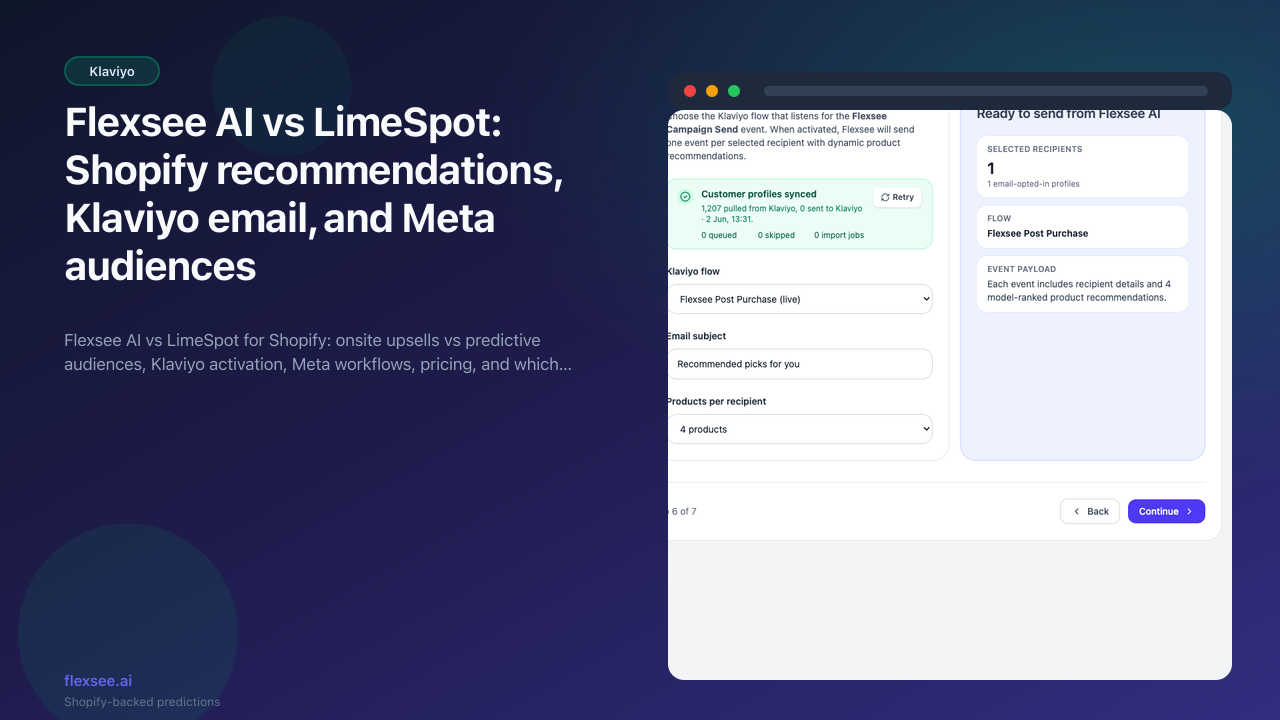
Shopify merchants comparing Flexsee AI and LimeSpot are usually trying to answer one question: should recommendation intelligence live primarily on the storefront, or should it power audiences and campaigns across Klaviyo, Meta, and other destinations?
LimeSpot is a Shopify and BigCommerce personalization app focused on onsite recommendations, bundles, upsells, checkout offers, post-purchase offers, and email/SMS personalization blocks. Flexsee AI is a Wizard Flow activation layer: sync a store, choose a destination, build predictive audiences, and activate those audiences through one guided flow.
This comparison is written for Shopify teams deciding whether to use LimeSpot, Flexsee, or both.
Executive summary
- Best for Flexsee AI when: You want Wizard Flow to turn commerce behavior into predictive audiences, then activate them in Klaviyo, Mailchimp, Meta Ads, and messaging channels from one dashboard.
- Best for LimeSpot when: You want Shopify-native onsite recommendations, bundles, frequently bought together, cart/checkout/post-purchase upsells, and theme-level personalization.
- Bottom line: LimeSpot is stronger for storefront conversion widgets. Flexsee is stronger for campaign activation and audience workflows beyond the storefront. Many merchants can use LimeSpot for onsite AOV and Flexsee for outbound growth.
At-a-glance comparison
| Dimension | Flexsee AI | LimeSpot |
|---|---|---|
| Primary job | Predictive audiences and campaign activation | Onsite product recommendations, bundles, upsells, and personalization |
| Main surface | Flexsee dashboard and Wizard Flow | Shopify app, theme/checkout placements, and personalization widgets |
| Data source | Connected commerce data sources: Shopify, WooCommerce, BigCommerce | Shopify or BigCommerce storefront, orders, products, customer and behavior data |
| Product recommendations | Wizard Flow recommendations for email/messaging and campaigns | Recommendations on homepage, PDP, cart, checkout, post-purchase, and order status pages |
| Klaviyo | Flexsee Campaign Send event with flexsee_recommendations | Works with Klaviyo; Max includes email/SMS personalization |
| Meta Ads | Wizard Flow audience prepare and campaign publish, including lookalike preparation | Not primarily a Meta campaign publishing tool; focuses on storefront and personalization journeys |
| Reporting | Dashboard and Campaigns views tied back to commerce revenue | Recommendation performance, conversion, click-through, and funnel analytics in LimeSpot/App Store listing |
| Shopify app pricing | Flexsee bills Shopify stores through Shopify App Pricing; non-Shopify stores through Stripe | Shopify App Store plans; Turbo order-tiered, Max revenue-tiered |
| Entry price | £29/month per connected commerce store | App Store lists Turbo from free/$9.99 and Max from $50, scaling by orders or revenue |
| Ideal merchant | Teams using Shopify data to drive Klaviyo, Meta, Mailchimp, and WhatsApp/SMS campaigns | Catalog stores that want more onsite cross-sell and upsell placements |
How Flexsee AI works for Shopify growth
Flexsee starts with your commerce data. A merchant connects Shopify under Integrations -> Datasources, approves the Flexsee Shopify app subscription, and lets Flexsee sync products, customers, and orders. Non-Shopify commerce sources such as WooCommerce and BigCommerce connect through Stripe-backed datasource subscriptions.
Once data is synced, the merchant starts in Wizard Flow. Flexsee handles prediction setup automatically inside the flow, then uses those recommendations to decide who should receive a campaign, which products each customer should see, and where to activate that audience.
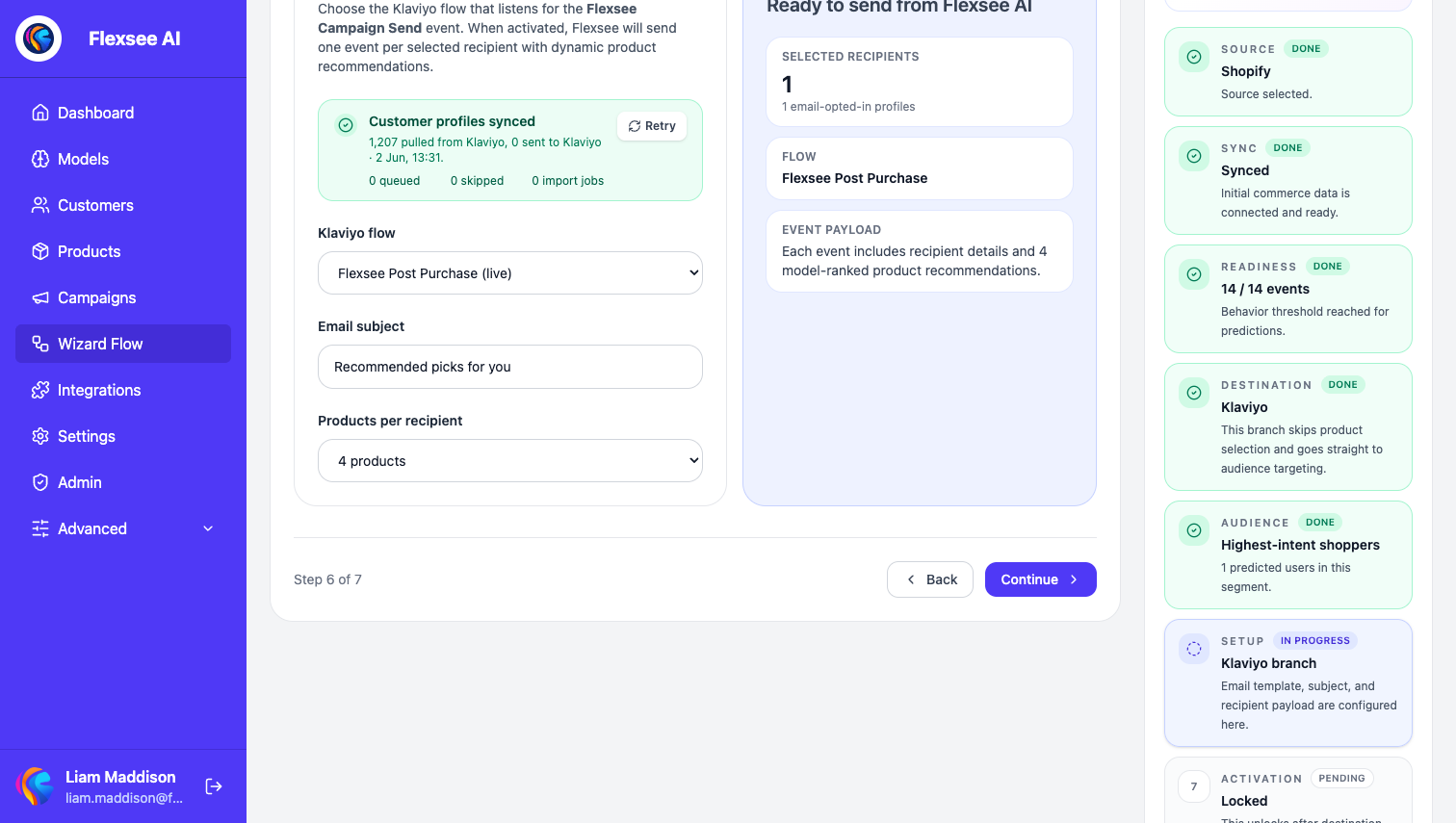
For Klaviyo, Flexsee sends one Flexsee Campaign Send event per selected recipient. The event contains flexsee_recommendations, flexsee_has_recommendations, the selected subject, and recipient/product context. The email is delivered by Klaviyo, while Flexsee supplies the audience and product picks. See How to trigger Klaviyo flows from Flexsee Campaign Send.
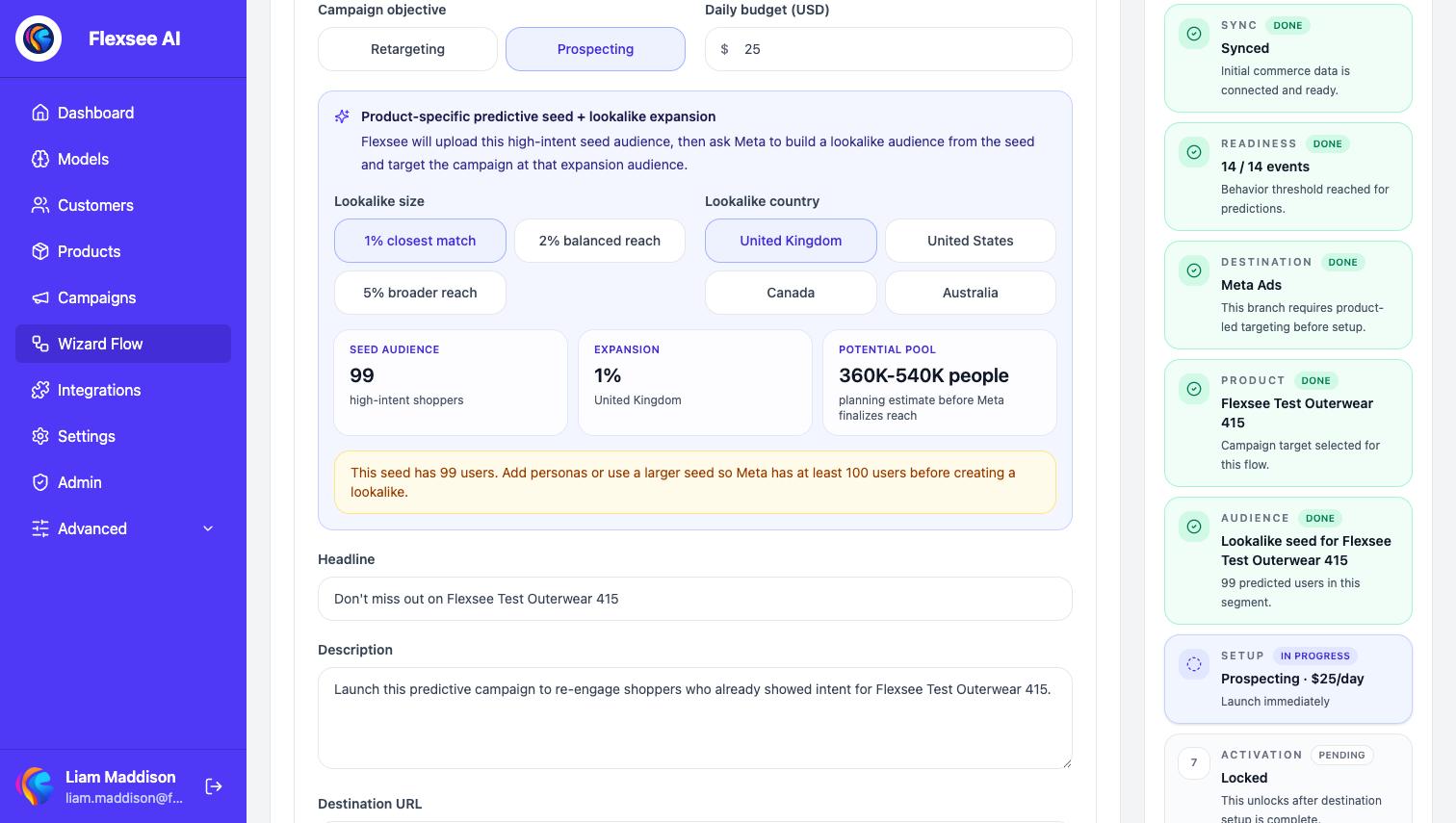
For Meta Ads, Wizard Flow supports preparing audiences and publishing campaigns. Retargeting uses a selected high-intent audience; prospecting can prepare lookalike audience settings. See Meta lookalike audiences from Shopify behavior and Meta campaign publish.
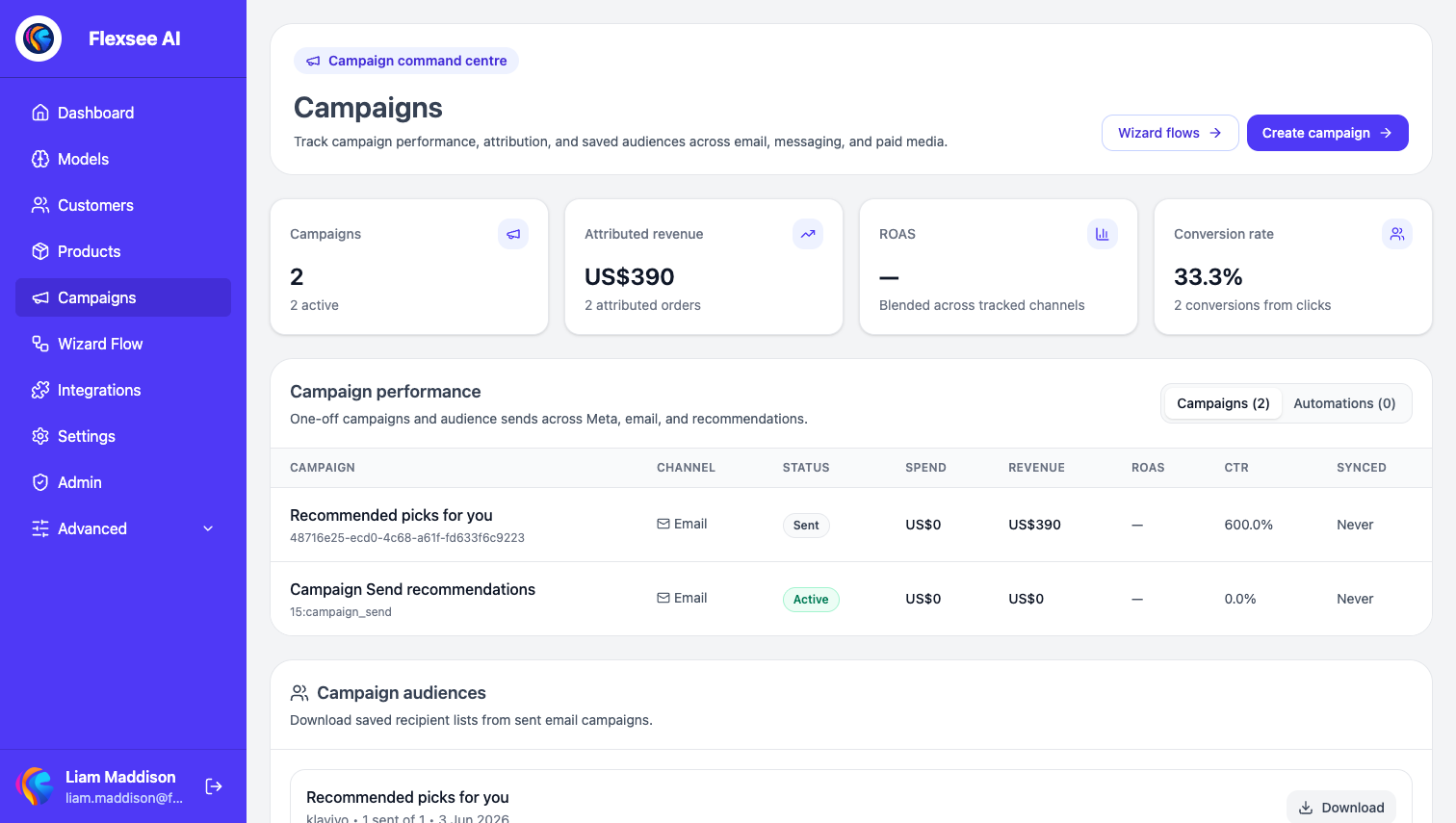
For performance reporting, Flexsee focuses on commerce-backed outcomes: revenue attribution, campaign views, and ROAS context that starts with store data rather than only ad-platform metrics.
How LimeSpot works for Shopify growth
LimeSpot is built around onsite commerce personalization. Its Shopify page describes a platform for AI-powered recommendations, segmentation, targeting, shapeshifting content, email/SMS/web personalization, and priority setup/support for Max customers. The Shopify App Store listing positions LimeSpot around bundles, upsells, cross-sells, frequently bought together, checkout, post-purchase, and order-status offers.
That makes LimeSpot a stronger fit when the primary problem is storefront merchandising:
- You want recommendation blocks on the homepage, PDP, cart, checkout, or thank-you page.
- You want frequently bought together bundles and one-click upsells.
- You want a Shopify-native tool that can be customized in the theme editor.
- You want A/B testing and recommendation analytics on storefront placements.
The App Store listing shows LimeSpot working with Checkout, Customer accounts, Shopify Flow, Shopify Admin, Klaviyo, LoyaltyLion, Okendo, Omnisend, SMSBump, and Yotpo. It also lists data access across products, customers, orders, discounts, marketing, store analytics, Online Store, and custom data.
Pricing has two shapes as of June 2026. LimeSpot’s Shopify page lists Turbo for growing brands, starting at $19.99/month for up to 250 orders per 30 days, and says Turbo is not available for Shopify Plus stores. It lists Max for established brands at $150/month for up to $50,000 revenue per 30 days, with advanced AI recommendations, segmentation, targeting, shapeshifting content, multi-channel personalization, priority support, setup, customizations, and onboarding.
The Shopify App Store listing also shows a free Turbo tier for up to 10 orders, Turbo from $9.99/month, and Max from $50/month, with fees increasing by orders or store revenue. In short: confirm the exact tier in Shopify App Store before installing, because public pages describe both order-based and revenue-based tiers.
Feature deep dive
Shopify and catalog data
Flexsee AI uses connected commerce stores as the billing and data unit. Shopify is billed through Shopify App Pricing; WooCommerce and BigCommerce are billed through Stripe. Once a store is subscribed and synced, the resulting products, orders, customers, and events feed Wizard Flow recommendations and campaigns.
LimeSpot uses Shopify data to personalize the storefront and shopping journey. Its App Store listing requests access to customers, products, orders, discounts, marketing, store analytics, Online Store, custom data, and other store data. That breadth makes sense for onsite widgets and checkout/post-purchase offers.
Product recommendations
Flexsee AI recommendations are campaign inputs. They appear in Klaviyo event payloads, Mailchimp sends, messaging flows, and prediction-backed audiences. The product is strongest when recommendations need to leave the store and become outbound campaigns.
LimeSpot recommendations are storefront placements. The App Store listing calls out smart recommendations on any page, personalized bundles, cart upsells, post-purchase upsells, and related product suggestions. If you need a visual recommendation block embedded into Shopify pages, LimeSpot is purpose-built for that.
Klaviyo and owned email
Flexsee AI uses Klaviyo as the delivery engine. You create a Klaviyo metric-triggered flow on Flexsee Campaign Send, add an HTML block that reads event.flexsee_recommendations, and select that flow in Wizard Flow. Flexsee sends one event per recipient with Wizard Flow product picks.
LimeSpot includes email and SMS personalization in Max, and the App Store lists Klaviyo as a supported integration. LimeSpot is likely stronger if you want storefront and email personalization controlled from the same onsite personalization platform. Flexsee is stronger if your main workflow is predictive segmentation plus campaign activation.
Meta Ads and paid social
Flexsee AI has an explicit Meta Ads workflow: connect Meta, prepare custom or lookalike audiences, validate destination and pixel readiness, then publish a campaign from Wizard Flow. The Meta path is part of the product flow, not an export-only side quest.
LimeSpot is not positioned as a Meta campaign publisher in the sources reviewed for this comparison. It may influence paid traffic conversion through personalized landing pages and product recommendations, but if the job is “build and launch a Meta audience from commerce predictions,” Flexsee is the closer fit.
Reporting and ROAS
Flexsee AI focuses on tying campaign activity back to commerce outcomes. The Campaigns and Dashboard surfaces are built for merchants who care about Shopify-backed revenue, Meta ROAS reconciliation, and owned-channel performance from the same source of truth.
LimeSpot reports recommendation performance, click-through rates, conversion rates, optimization suggestions, and funnel performance for its onsite placements. That is the right reporting model for widgets and upsell blocks.
Pricing and total cost
Flexsee AI uses per-datasource billing: £29/month per connected commerce store. Shopify stores pay through Shopify App Pricing. WooCommerce and BigCommerce stores pay through Stripe. Meta, Klaviyo, Mailchimp, and other destinations are included when at least one commerce datasource subscription is active.
LimeSpot is tiered by Shopify plan/product line. Public sources show Turbo and Max, with pricing based on orders or revenue. Max is listed at $150/month for up to $50,000 in 30-day online store revenue on LimeSpot’s pricing page, while the App Store lists Max from $50/month and says it increases with revenue. Treat the App Store checkout as the source of truth before you commit.
Workflow comparison
Scenario A — Launch a Klaviyo recommendation campaign
- With Flexsee: Connect Shopify and Klaviyo, create a Klaviyo flow triggered by Flexsee Campaign Send, select a predictive audience in Wizard Flow, choose the Klaviyo flow, set subject and product count, then Send email.
- With LimeSpot: Use LimeSpot’s personalization data and Klaviyo integration to personalize email/SMS experiences where configured. LimeSpot is strongest when the email strategy is tied to onsite recommendation logic and the LimeSpot platform.
Scenario B — Add product recommendations to product pages and checkout
- With Flexsee: Not the primary use case. Flexsee is not a theme-native recommendation widget platform.
- With LimeSpot: Install the Shopify app, configure recommendation, upsell, cross-sell, bundle, checkout, post-purchase, and order-status placements.
Scenario C — Build Meta prospecting from commerce behavior
- With Flexsee: Use Wizard Flow for Meta, choose prospecting, prepare audience and lookalike settings, then publish or review the campaign path.
- With LimeSpot: Use onsite personalization and landing-page conversion improvements around paid traffic, but use a separate Meta workflow for audience creation and campaign publishing unless LimeSpot has a specific add-on in your plan.
Where Flexsee AI is stronger
- Predictive audience activation: Flexsee is built around audiences, destinations, and Wizard Flow rather than theme widgets.
- Meta campaign workflow: Flexsee has a product path for Meta audience preparation and publish.
- Klaviyo event payloads: Flexsee sends
flexsee_recommendationsthrough Flexsee Campaign Send, making the Klaviyo flow explicit and inspectable. - Cross-platform commerce billing: Shopify, WooCommerce, and BigCommerce can be connected as separate commerce sources with clear per-source billing.
- ROAS context: Flexsee leans into store-backed revenue reporting and campaign performance, not only recommendation block analytics.
Where LimeSpot is stronger
- Onsite merchandising: LimeSpot is purpose-built for homepage, PDP, cart, checkout, post-purchase, and order-status recommendations.
- Bundles and upsells: Frequently bought together, bundle offers, cart upsells, and post-purchase offers are first-class in LimeSpot’s App Store positioning.
- Theme and checkout integration: LimeSpot is a Shopify app with placements directly in the buying journey.
- A/B testing for recommendation blocks: LimeSpot lists A/B testing, recommendation performance, funnel performance, and optimization suggestions.
- Done-for-you setup: LimeSpot’s Max messaging emphasizes free setup, customization, onboarding, and priority support.
Can you use both?
Yes. The products overlap in the word “recommendations,” but the surfaces are different.
A practical combined setup is:
- LimeSpot for onsite product recommendations, bundles, checkout upsells, and post-purchase offers.
- Flexsee AI for predictive audiences, Meta activation, Klaviyo Campaign Send events, Mailchimp sends, and performance reporting from commerce data.
The main thing to watch is attribution. If LimeSpot claims revenue from onsite recommendation clicks and Flexsee tracks campaign outcomes, make sure your reporting process explains which tool influenced which moment. LimeSpot may improve conversion after a visitor lands; Flexsee may improve which audience or customer receives the campaign in the first place.
Frequently asked questions
Is Flexsee AI a LimeSpot replacement?
Not for onsite widgets. If your main need is product page recommendations, cart upsells, and post-purchase offers, LimeSpot is closer to the job. Flexsee is a better replacement when you are using recommendations to drive campaign audiences and outbound channels.
Is LimeSpot a Flexsee alternative?
Only for a subset of recommendation use cases. LimeSpot can personalize email/SMS and onsite journeys, but Flexsee has dedicated Wizard Flow paths for Klaviyo events, Meta audience preparation, and campaign activation.
Which is cheaper?
Flexsee is simple at £29/month per connected commerce store. LimeSpot pricing depends on product line and tier. Public pages show Turbo order-based pricing and Max revenue-based pricing, with Max listed at $150/month for up to $50,000 revenue per 30 days on LimeSpot’s pricing page.
Which should a small Shopify store choose first?
If you need onsite upsells immediately, try LimeSpot Turbo or Max. If you need Klaviyo, Meta, or Mailchimp audiences from commerce predictions, start with Flexsee. If budget allows, use each for its strongest surface rather than forcing one to do both jobs.
Does Flexsee work with WooCommerce and BigCommerce?
Yes. Flexsee bills non-Shopify commerce sources through Stripe and unlocks destinations when an active commerce datasource subscription exists.
Methodology & updates
- Flexsee features verified: 2026-06-29 against the Flexsee repository and deployed per-datasource billing model.
- Competitor facts verified: 2026-06-29 from LimeSpot pricing, LimeSpot for Shopify, and the LimeSpot Shopify App Store listing.
- Post last updated: 2026-06-29.
Vendor features and pricing change. Confirm current pricing, app compatibility, and data access in Shopify App Store and the vendor dashboard before purchasing. LimeSpot is a trademark of its respective owner.
Comments